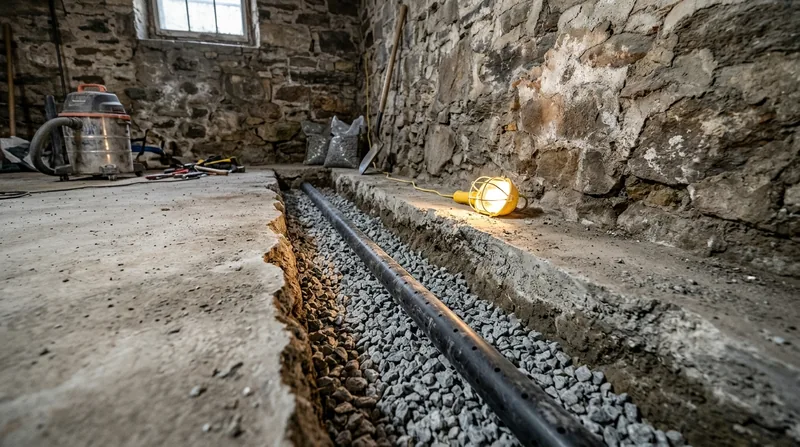




Framingham sits on glacial till and sandy outwash over ledge, and the low lots near Cochituate Brook and the Sudbury River carry a high water table that pushes water up under the slab every spring. In the 1900s-1940s houses downtown and in Saxonville, that means fieldstone and brick cellars that weep through the mortar, while the 1950s-1970s ranches and split-levels in Nobscot and along the older village streets have poured full basements that crack at the cold joints and take water at the cove. If you are searching for an Interior Drain Tile System in Framingham, you are usually past the point of sealing a crack and into the point where water rises under the floor faster than any coating can stop it. We install interior perimeter drain tile beneath the slab edge, capture the water at the footing, and channel it to a sump basin that pumps it out and away from the house. It works in any season, which matters when the nor'easter rain and spring melt hit the same basement in the same month. For the wider picture of how this fits with wall sealing and discharge work, start with our basement waterproofing service.
Why Framingham Basements Take Water at the Footing, Not Just the Wall
Most of the wet basements we open in Framingham are not leaking through a single visible crack. The water is coming up through the slab-to-wall joint and the footing itself, driven by hydrostatic pressure from a water table that sits high in the low ground near the Sudbury River and the Cochituate Brook corridor. Fieldstone and brick foundations in Saxonville and downtown let that water through the stone and mortar before it ever reaches a modern crack. The freeze-thaw cycles of a Framingham winter open older walls further, and the spring melt finds every joint that was already tired.
- Hydrostatic pressure lifts water through the footing drain and the slab edge, so the floor stays damp even when the walls look dry.
- Older fieldstone and brick cellars in Saxonville wick water through the stone and show efflorescence on the mortar.
- Poured basements in the 1950s-1970s ranches crack at cold joints and at the cove where the slab meets the wall.
- Glacial clay soil slows drainage, so water stands against the footing longer after a nor'easter.
- Original weeping tile at the footing clogs or collapses over 60 to 100 years, and the water has nowhere to go but up.
When the water is rising under the floor, an interior perimeter drain is the honest answer, and it is a better fit than exterior excavation on most of these lots.
Key info: On a 1920s fieldstone cellar off Waverly Street in Framingham, the wall was dry above grade but the floor was wet every March. The water was coming up at the footing, not through the stone, and an interior drain tile system with a new sump basin was the correct repair. Sealing the wall alone would have failed by the next spring melt.
Permits for work that alters drainage or the sanitary connection of a sump discharge vary by jurisdiction, and the Framingham building department is the authority to confirm the current requirements before any work starts. You can review the city's permit information at the City of Framingham official site.
How We Install an Interior Drain Tile System in a Framingham Basement
We start by walking the basement and the grade outside, because the fix depends on where the water is actually entering. On a poured basement in Nobscot we look at the cove and the cold joints. On a fieldstone cellar in Saxonville we look at the mortar and the footing. Then we set the layout, cut the slab edge, and install the drain in a washed stone bed against the footing, pitched to the sump basin. We finish with a new sump pump, a check valve, and a discharge line that carries water well away from the foundation.
- We inspect the basement, the footing, and the exterior grade to confirm the water is rising under the slab and not entering from a failed downspout or a high grade line.
- We cut a channel along the perimeter of the slab, typically 12 to 16 inches wide, and remove the concrete and subbase down to the footing.
- We install the perforated drain tile in a bed of washed stone against the footing, with a filter fabric to keep glacial clay fines out of the pipe.
- We set the sump basin at the low point, connect the drain tile to it, and install the pump, check valve, and discharge line.
- We backfill with stone, pour a new concrete cap over the channel, and test the system with water before we leave.
- We route the discharge to daylight or a dry well, and we check the downspout extensions and grading so the water does not come straight back to the footing.
The result is a system that captures water at the footing and moves it out, instead of letting it sit against the wall and under the slab.
Key info: A 1960s split-level on the Ashland side of Framingham had a finished basement that flooded every spring. The original footing drain was collapsed clay tile. We installed a new interior perimeter drain and sump basin, tied the discharge to a dry well, and the floor has stayed dry through two spring melts. The homeowners kept the finished room instead of tearing it out.
If the footing drain itself is failing and you need a targeted repair rather than a full perimeter system, our drain tile repair and replacement service covers that scope.
Interior Drain Tile Methods We Use in Framingham
Not every wet basement needs the same drain detail. The right method depends on the foundation type, the water table, and whether the basement is finished. Here is how we match the approach to the house.
| Approach | Description | Best for |
|---|---|---|
| Full perimeter interior drain | Drain tile installed along the entire slab edge, pitched to a central sump basin. | Wet floors and damp walls on all sides, common in low lots near the Sudbury River. |
| Partial interior drain | Drain tile on the wet wall or walls only, tied to a sump basin at the low corner. | One-sided seepage on a hillside lot in Hopkinton or the Marlborough border tracts. |
| Drain tile with dimple board | Interior drain plus a dimple board membrane on the wall to relieve damp masonry. | Fieldstone and brick cellars in Saxonville that wick water through the stone. |
| Drain tile with sump and battery backup | Interior drain, primary sump pump, and a battery backup pump for power loss. | Finished basements and any home where a storm outage coincides with high water. |
| Drain tile with vapor barrier | Interior drain plus a sealed vapor barrier over the slab and walls. | Basements with musty odor and moisture control problems, not just standing water. |
We size the system to the actual water load, not to a standard package, because a Framingham lot near the river behaves differently from a hillside walkout in Hopkinton.
Interior Drain Tile System Cost in Framingham: What to Expect
Interior drain tile pricing starts from $50 per linear foot, and that figure covers the slab cutting, the washed stone bed, the perforated drain tile, the sump basin, and the new concrete cap. The final number moves with the length of the run, the foundation type, and whether the basement is finished. A fieldstone cellar in Saxonville takes more time at the footing than a clean poured wall in a 1980s subdivision off the Marlborough border. Access matters too: a bulkhead door and a tight stairwell slow the concrete removal.
We quote the sump pump, check valve, and discharge line as part of the system, because a drain without a working pump is just a wet trench. If the discharge has to be routed to a dry well or daylight, that is a separate line item and we say so up front. Getting two or three estimates is smart on a job this size, and we would rather you compare scope than compare a single number. Our full pricing overview shows how the line items break down.
Interior Drain Tile System Near Me: How to Vet a Framingham Contractor
When you search for an interior drain tile system near me in Framingham, the first thing to confirm is licensed and insured status, and then to ask for the certificate, not just the claim. Ask whether the company pulls the permit when one is required for drainage or sump discharge work, and confirm who is responsible for the inspection. Ask for references from Framingham or a neighboring town on a similar foundation, and ask what happens if the basement is still wet after the first spring melt.
Get the scope in writing, including the sump pump model, the discharge route, and the warranty terms. A transferable warranty is worth more than a verbal promise, and a contractor who explains when simple crack sealing is enough is more useful than one who sells a full system to every caller. We are happy to walk you through the scope before you commit. Reach us through our contact page to set up a free basement inspection.
Interior Drain Tile System in Framingham: Pricing Guide
| Service | Price | Details |
|---|---|---|
| Full perimeter interior drain | Starting at $50/linear ft | Includes slab cutting, washed stone bed, perforated drain tile, sump basin, and new concrete cap. |
| Partial interior drain | Starting at $50/linear ft | One or two wet walls only, priced by run length and tied to a corner sump basin. |
| Drain tile with sump pump package | On estimate | Pump model, check valve, and discharge route priced after we confirm the water load and outlet. |
| Finished basement protection | On estimate | Floor protection, dust control, and careful slab work add labor on finished lower levels. |
| Travel | Included | In Framingham and surrounding areas, no separate call-out or mileage fee. |
| Estimate | Free | Response within 24h at (774) 217-6942, no obligation to book. |
Indicative pricing, the exact cost depends on square footage, finish, and site access. Free personalized estimate within 24h at (774) 217-6942.


