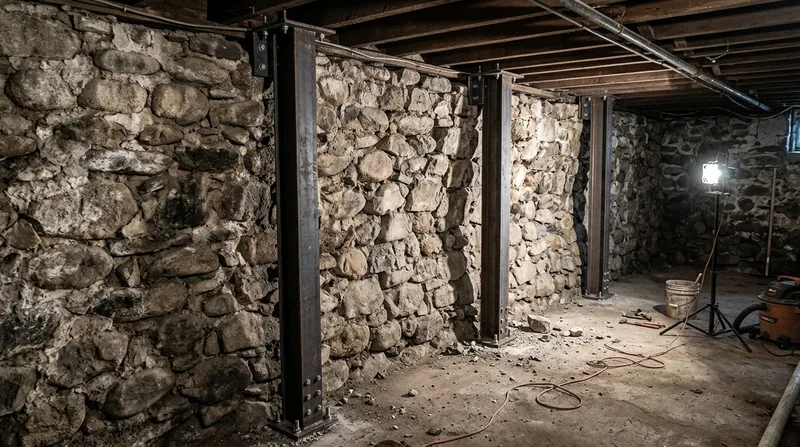




Framingham sits on glacial till and sandy outwash over ledge, and that ground moves with the seasons. In Saxonville and the older downtown streets, 1900s to 1940s houses still carry fieldstone and brick cellars that lean inward after decades of frost and saturated soil. Out in Nobscot and the older village streets, 1940s to 1960s Cape Cods and colonials have full basements of early block or brick, and a hard winter can push a wall out of plumb by an inch or more. If you have a bowing wall repair in Framingham problem, you are usually looking at hydrostatic pressure from the low lots near Cochituate Brook and the Sudbury River, combined with freeze-thaw cycles that open older walls. We stabilize leaning and bowing walls with carbon fiber straps, steel I-beams, or wall anchors, matched to how far the wall has moved and how much soil pressure sits behind it. Start with a free basement inspection so we can measure the movement before anyone quotes a repair.
Why Bowing Walls Show Up So Often in Framingham's Older Basements
The dominant failure mode here is lateral soil pressure against walls that were never engineered for it. Fieldstone and brick cellars in Saxonville and downtown Framingham were laid with lime mortar that softens as it stays wet, and the glacial clay soil behind them holds water instead of draining it. When the water table rises in spring melt or a nor'easter, that saturated soil pushes inward, and the wall bows at mid-height where it has the least support.
- Fieldstone and brick walls in 1900s to 1940s homes lean because the mortar joints crush and the wall racks inward.
- Early block walls in Nobscot Cape Cods crack horizontally at the mortar line when hydrostatic pressure builds behind them.
- Poured walls in 1950s to 1970s split-levels develop vertical or stair-step cracks that widen through freeze-thaw cycles.
- Old bulkhead doors and failed downspout extensions let water pool at the foundation, which keeps the soil saturated year after year.
- Efflorescence and white staining on the wall face tell you water is moving through the masonry, not just sitting against it.
Any of those signs means the wall is telling you something. We measure the bow with a plumb line and a straightedge before we recommend straps, beams, or anchors.
Key info: On a 1920s fieldstone cellar off Central Street in Framingham, we found a 2-inch bow at mid-wall with a wet base and heavy efflorescence. The fix was carbon fiber straps plus regrading and a downspout extension, not exterior excavation, because the wall had not rotated at the footing.
For the official word on structural permits, check the City of Framingham building department before any structural repair begins.
How We Repair a Bowing Wall in Framingham, Step by Step
We start by finding out whether the wall is bowing, rotating, or both, because the repair changes with the movement. A wall that has rotated at the top needs anchors or beams that tie back into stable soil. A wall that bows at mid-height with sound top and bottom plates is usually a candidate for carbon fiber straps. We check the footing drain and the grading too, because a repair that ignores the water source will not hold.
- We inspect the wall from inside and out, measure the deflection, and check for horizontal cracking, stair-step cracking, and footing movement.
- We map the water source: roof discharge, grading, window wells, and the condition of the old drain tile at the footing.
- We recommend the method that matches the severity, which may be carbon fiber straps, steel I-beams, or wall anchors.
- We pull the permit where the local building department requires one for structural foundation repair.
- We install the system, tension anchors or set beams to plumb, and seal penetrations.
- We correct the water problem with grading, downspout extensions, or an interior drain tile system so pressure does not rebuild.
The repair stabilizes the wall. Controlling the water is what keeps it stable.
Key info: A 1960s ranch on the Ashland side of Framingham had a block wall bowing 1.5 inches after a wet spring. We installed steel I-beams at 4-foot spacing and extended the downspouts 6 feet away from the foundation. Two winters later the wall had not moved.
If the crack is the main issue rather than the bow, see our foundation crack repair page for injection options.
Repair Methods We Use and When Each One Fits
No single method fits every wall. The table below shows how we match the approach to the movement and the soil pressure behind it.
| Approach | Description | Best for |
|---|---|---|
| Carbon fiber straps | Straps bonded vertically to the wall face and anchored top and bottom to resist inward bowing. | Block or poured walls with mid-height bowing and sound top and bottom plates. |
| Steel I-beams | Beams set against the wall and tied into the floor and joists to hold the wall plumb. | Heavier bowing, longer walls, and walls where straps alone are not enough. |
| Wall anchors | Anchor plates in stable soil outside tied to interior plates, with the wall pulled back toward plumb. | Walls that have rotated or bowed and where exterior access is available. |
| Epoxy or polyurethane injection | Injection ports seal active cracks and fill voids behind the wall. | Cracks that are leaking but where the wall has not bowed significantly. |
| Drainage correction | Grading, downspout extensions, and drain tile work to relieve hydrostatic pressure. | Every repair, because the water source has to be controlled. |
The right combination depends on the wall, not on a package price.
Bowing Wall Repair Cost in Framingham: What to Expect
Pricing for bowing wall repair starts from $600 for minor crack sealing and small stabilization work, and most structural repairs run well above that once straps, beams, or anchors are involved. The number moves with the length of the wall, the amount of deflection, the wall material, and whether we need to correct drainage at the same time. Access matters too: a wall behind a finished basement or a tight bulkhead takes more labor than an open cellar.
Fieldstone walls in Saxonville often need more prep because the mortar has to be addressed before straps go on. Poured walls in the 1980s and 2010s subdivisions on the Hopkinton and Marlborough borders are usually more straightforward. Get two or three estimates and ask each contractor to explain the method and the measurements behind it. Our full pricing overview shows how the line items break down.
Choosing a Bowing Wall Repair Contractor Near Framingham
Ask for proof of licensing and insurance before anyone touches a structural wall. Massachusetts requires a home improvement contractor registration, and a legitimate contractor will hand over a certificate of insurance without a fuss. Get at least three written estimates that name the method, the measurement of the bow, and what happens to the water. Ask for references from jobs in Framingham or nearby towns with the same wall type, and call them.
Confirm who pulls the permit, because structural foundation repair commonly requires one and the rules vary by jurisdiction. If your home is in a historic district, check with the city before exterior anchor work. Then compare the scope, not just the price. Reach us through the contact page to set up an inspection.
Bowing Wall Repair in Framingham: Pricing Guide
| Service | Price | Details |
|---|---|---|
| Crack sealing and minor stabilization | Starting at $600 | Includes injection of active cracks and spot sealing, with price rising by crack length and access |
| Carbon fiber strap installation | Starting at $1,200 | Includes straps anchored top and bottom, with price set by wall length and number of straps |
| Steel I-beam or wall anchor system | Starting at $2,500 | Includes beam or anchor installation and tensioning, with price driven by wall length and soil access |
| Complex or large-scale job | On estimate | Long walls, finished basements, or combined structural and drainage work need an on-site look first |
| Travel | Included | In Framingham and surrounding areas, no separate call-out or mileage fee |
| Estimate | Free | Response within 24h at (774) 217-6942, no obligation to book |
Indicative pricing, the exact cost depends on square footage, finish, and site access. Free personalized estimate within 24h at (774) 217-6942.


