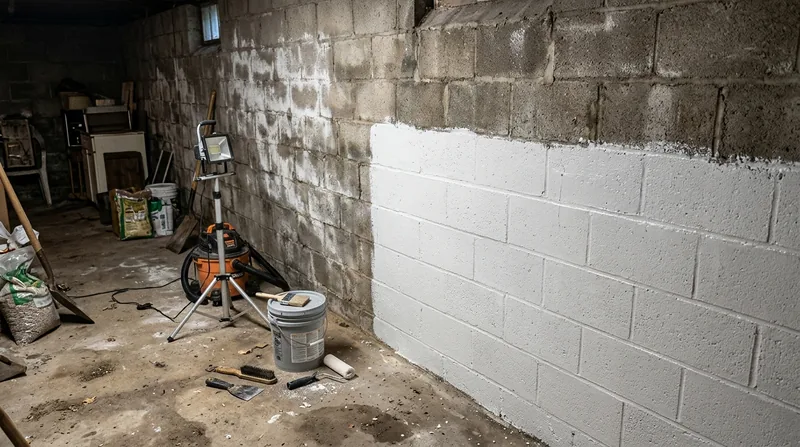




Why Basement Wall Sealing Matters in Framingham's Older Housing Stock
Framingham sits on glacial till and sandy outwash over ledge, and the low lots near Cochituate Brook and the Sudbury River carry a high water table that pushes water against foundations every spring. The downtown and Saxonville blocks are full of 1900s to 1940s houses with fieldstone and brick cellars, and those stone walls weep through the mortar joints no matter how many times someone has parged them. Nobscot and the older village streets have 1940s to 1960s Capes and colonials with early block or brick basements and old bulkhead doors that let in both water and cold air.
If you have damp walls, white powder on the block, or a musty smell after rain, basement wall sealing in Framingham is the first thing to evaluate, but only after we confirm what is actually driving the moisture. A sealer over an active hydrostatic problem traps water behind the coating and makes it worse. We tell you plainly which situation you have before we quote anything.
Call (774) 217-6942 for a free basement inspection, or start with our basement waterproofing service page to see how sealing fits into a full water-management plan.
Framingham's Freeze-Thaw Cycles and the Wall Seepage They Cause
Winters here bring deep frost and repeated freeze-thaw cycles, and that is the failure mode that dominates in this city. Water enters a hairline cold crack or a porous mortar joint in the fall, freezes, expands, and widens the opening a little more each season. By the time the spring melt arrives, a wall that was tight ten years ago is weeping along the block courses.
The symptoms Framingham homeowners describe to us follow a predictable pattern:
- Efflorescence, that white chalky bloom, appears on the lower block courses after the first wet spring.
- Wall seepage shows up within 24 to 48 hours of a nor'easter or a long soaking rain.
- A musty basement smell lingers even when the floor is dry to the touch.
- Paint or parging flakes off the wall in sheets because moisture is pushing from behind.
- Water tracks along the wall-to-floor joint where the old footing drain has silted shut.
Any one of these signals is worth a look, and two or more together usually mean the wall needs more than a coating.
Key info: A 1920s fieldstone cellar in Saxonville and a 1965 poured-wall ranch in Nobscot fail for different reasons. On the stone wall we often find mortar joints that need repointing before any sealer can hold; on the poured wall we usually find cold cracks at the form ties. We scope the sealer to the wall type, not to a one-size product.
For the official word on what work needs a permit in Framingham, check the Town of Framingham building department at framinghamma.gov before you schedule anything structural.
How We Seal a Basement Wall in Framingham, Step by Step
Sealing a damp wall is a surface job, but the prep is where the work lives. We start by finding out whether the moisture is surface condensation, capillary draw through the masonry, or active hydrostatic pressure. That answer decides whether a penetrating sealer will do the job or whether you need crack injection or an interior drain before any coating goes on. Skipping this step is how homeowners end up paying twice.
- We walk the basement and the exterior grade, noting downspout discharge, window wells, and any sign of a high water table.
- We test the wall for moisture and map the efflorescence and crack pattern so we know where water is actually entering.
- We grind or wire-brush the surface and remove loose parging, old paint, and efflorescence down to sound masonry.
- We inject active cracks with epoxy or polyurethane before sealing, because a sealer will not bridge a moving crack.
- We apply the penetrating sealer or membrane coating in the specified number of coats, keeping the wall-to-floor joint open if drainage is planned.
- We correct grading and extend downspouts so the water we just sealed out is not dumped back against the footing.
The job is not finished until the water has somewhere else to go, and that is why we treat grading and discharge as part of the sealing scope.
Key info: On a 1950s split-level off Concord Street, the walls were damp only on the uphill side. The sealer alone would have failed within a season. We sealed the wall, then tied the downspouts into a discharge line that carries roof water to the daylight grade, and the dampness stopped. Same wall, different outcome, because we fixed the source.
If the inspection shows water coming through the footing rather than the wall face, the better answer is usually an interior drain tile system rather than more sealer, and we will say so.
Sealing Approaches We Use on Framingham Basements
Not every damp wall needs the same product. The table below shows the approaches we actually specify in this market and what each one is suited for.
| Approach | Description | Best for |
|---|---|---|
| Penetrating sealer | Silicone or silane product that soaks into the masonry and blocks capillary draw without a surface film. | Damp block or brick walls with no visible running water. |
| Membrane coating | Flexible cementitious or elastomeric coating that bridges hairline cracks and resists mild pressure. | Poured walls with cold cracks and light seepage after rain. |
| Epoxy injection | Structural injection that fills and bonds a stable, non-moving crack in poured concrete. | Settled cold cracks and form-tie holes in poured foundations. |
| Polyurethane injection | Flexible foam injection that seals an active leak and tolerates minor movement. | Actively leaking cracks and wet wall-to-floor joints. |
| Parging and repointing | Mortar repair of eroded fieldstone or brick joints before any sealer is applied. | Older stone and brick cellars in Saxonville and downtown. |
We pick from this list based on the wall material and the moisture source, and we explain the choice before the work starts.
Basement Wall Sealing Cost in Framingham: What to Expect
Most basement wall sealing jobs in Framingham start at $1,500 and move up from there. That starting figure covers a straightforward single-wall or partial-perimeter sealing job on a sound wall with normal prep. The number climbs when the wall needs repointing, when active cracks need injection first, or when the basement is finished and we have to work around drywall and stored belongings.
The factors that move the price most are wall length, wall material (fieldstone takes far more prep than poured concrete), crack count, access to the wall, and whether grading or downspout work is included. A full-perimeter job on a large poured basement with several injected cracks will land well above the starting point, and we will tell you that on the first visit rather than after the fact.
Get two or three written estimates and compare scope, not just the bottom line. A low bid that skips crack injection or surface prep is not the same job. Our full pricing overview shows how we build the number.
Choosing a Basement Wall Sealing Contractor Near Me in Framingham
Hiring for basement wall sealing near Framingham comes down to a few checks that separate a specialist from a general handyman with a bucket of sealer. Ask for the license and insurance certificate, confirm the company carries general liability and workers' compensation, and ask how they diagnose the moisture source before quoting. A contractor who quotes a sealer without inspecting the wall is guessing.
- Confirm the company is licensed and insured and ask to see the certificate before work begins.
- Get at least three written estimates that spell out prep, materials, and crack treatment.
- Ask for references from Framingham, Marlborough, or Hopkinton jobs done in the last two years.
- Ask whether the scope needs a permit from the local building department, since structural repair and drainage changes can trigger one.
- Check that the quote explains what happens if the wall turns out to need injection or drainage once it is opened up.
Good contractors welcome these questions, and the answers tell you more than any brochure.
Ready to schedule? Reach us through our contact page or call (774) 217-6942 for a free, no-obligation inspection.
Basement Wall Sealing in Framingham: Pricing Guide
| Service | Price | Details |
|---|---|---|
| Single wall penetrating sealer | Starting at $1,500 | Includes surface prep, efflorescence removal, and one coat on a sound wall up to about 30 linear feet. |
| Membrane coating with crack prep | Starting at $2,200 | Includes grinding, hairline crack treatment, and two-coat membrane on a poured wall section. |
| Full perimeter sealing with injection | Starting at $3,800 | Includes perimeter prep, epoxy or polyurethane injection of active cracks, and full coating. |
| Fieldstone or brick repointing plus sealer | On estimate | Older stone and brick walls need joint assessment before a number is possible. |
| Estimate and inspection | Free | On-site moisture diagnosis within 24 hours at (774) 217-6942, no obligation to book. |
Indicative pricing, the exact cost depends on square footage, finish, and site access. Free personalized estimate within 24h at (774) 217-6942.


